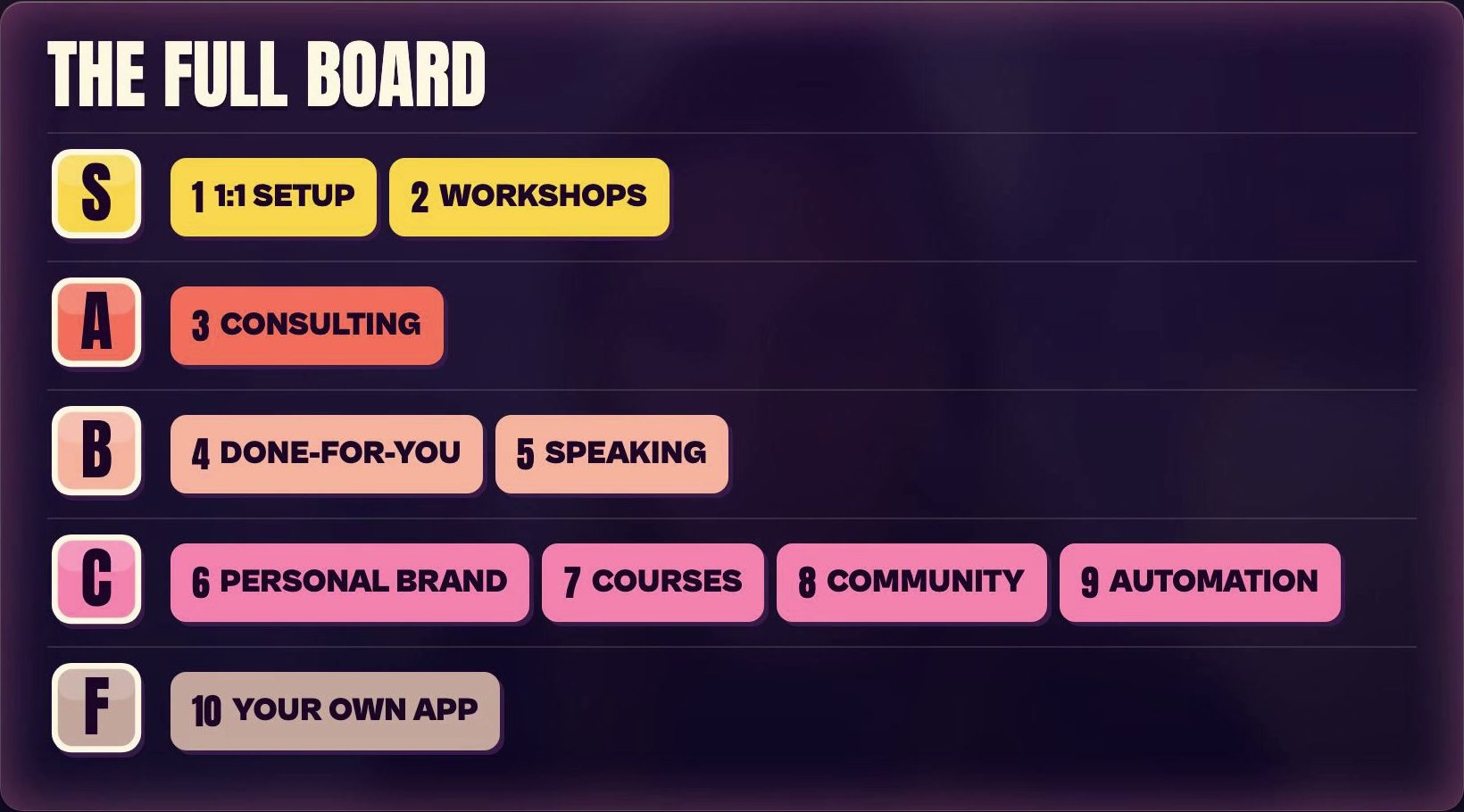
If you're starting from zero, the fastest ways to make money with AI are 1:1 AI setup sessions and workshops (both S tier), then consulting (A tier). I ranked 10 real ways to make money with AI by one thing: how fast a beginner actually gets paid. Building your own app came last, and the AI automation agency most people start with landed in C tier.
Most people who want to make money with AI start with the hardest option: custom builds and an AI automation agency. I've made money from most of the ways on this list myself, so you get my real numbers. And for every one, I'll tell you exactly how I'd land the first paying customer.
If we haven't met, I'm Brooke. I own Wright Mode, an AI community for women who want to actually make money with AI. I grew my business to multiple six figures in less than a year, and I've got almost 100,000 followers across all my channels combined.
The 10 ways to make money with AI, ranked
If tier lists are new to you: S is the top, then A, B and C, and F is the bottom. The tiers rank speed to your first payment, not how much each one can earn eventually. A C tier here can still be a brilliant business. It's just a slow first sale.
| Way to make money | Tier | Why it sits there | First step to a paying customer |
|---|---|---|---|
| 1. 1:1 AI setup sessions | S | No audience or website needed. You can get paid this week. | Message five business owners you already know |
| 2. Workshops and team training | S | Build it once, run it again and again. Team fees pay more. | Offer a 60-minute "AI for your industry" session to a group you're already in |
| 3. AI consulting and advisory | A | You need some business experience to give advice | Talk to the people who put their hand up after your workshop |
| 4. Done-for-you services with AI | B | Quick if you already have the skills and the clients. Slow from scratch. | Build a Claude skill for the task you do for most clients |
| 5. Speaking gigs | B | Slower to get paid, and speaking is a skill you have to learn | Free talks at local business groups, filmed for a speaker reel |
| 6. Personal brand and brand deals | C for fast money, S for potential | Takes a long time to build, but makes every other way easier | Pick one platform and post daily about how you use AI |
| 7. Courses and digital products | C | Works once you have an audience, hard without one | Run it as a live workshop first |
| 8. Paid community | C | A numbers game, and a lot of work | Build towards it after workshops and consulting |
| 9. AI automation agency | C | Hard to scope, messy client systems, things break, and building is getting cheaper | One industry, one automation, sold over and over |
| 10. Building your own app | F (for beginners) | Fast to build, slow to find people who'll pay | Don't start here without an audience |
1. 1:1 AI setup sessions (S tier)
You sit down with a small business owner, over Zoom or even at their kitchen table, and help them set up AI for their business. It's their laptop and their account. You're helping them set up Claude or ChatGPT for their business. So many business owners are overwhelmed right now. They know they need to use AI, and they don't even know where to start.
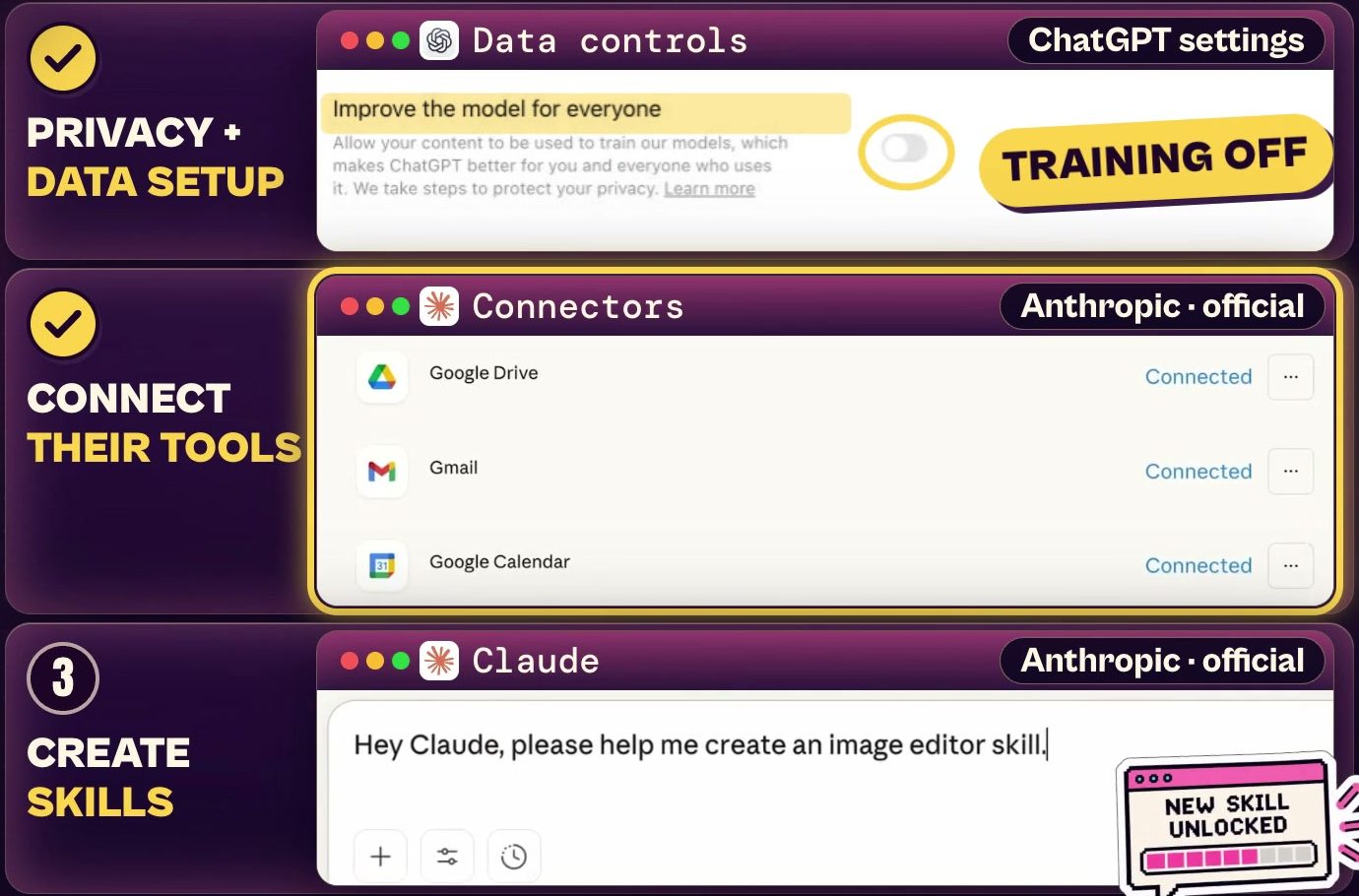
In an hour, I'd get through three things:
- Privacy and data setup. Go through their settings together so they know what they're sharing, including whether their chats can be used to train the model.
- Connecting their tools. Plug in the apps they already live in, like Google Drive and Gmail. Here's how Claude connectors work with Gmail and your calendar if you want to see that part.
- Creating skills. Help them create their first skills, so AI starts doing real tasks in their business.
This is a super fast way to make money with AI because you only need to know a little bit more than the person you're teaching. If you've read this far, you probably already do.
What to charge: my version of this today is a 90-minute consulting call at A$3,000 plus GST. You don't need to start there. Charge a couple of hundred dollars to begin with, then raise the price as the clients and testimonials come in.
Your first paying customer: message five business owners you already know. Warm outreach is the fastest path when you don't have an audience. All you need to say is something like:
I'm doing 5 AI setup sessions this month. 1 hour on your laptop and you'll walk away feeling less overwhelmed by AI, have it actually working on tasks in your business. Do you want one?
That's it! S tier for sure. You don't need an audience, you don't even need a website yet, and you can get paid this week.
2. Workshops and team training (S tier)
Same idea as No. 1, but you're teaching a room or a whole team. This is my absolute favourite for beginners. You build the workshop once, then rinse and repeat, tweaking it slightly for each audience or team you train.
My in-person Coding Camp is capped at 15 seats. I teach women to use coding tools like Codex and Claude Code, I've run it in multiple cities around Australia, and it has sold out every single time. I also run online workshops and talks for business owners. When I was first starting out, I ran a free Intro to AI and Automations workshop every six weeks to grow my audience, build my authority and start an email list.
What to charge: you can price a workshop two ways. Per head for public workshops, where you're targeting business owners. Or a flat fee for a team training. The team fee is where the bigger money is, because the business pays for it out of its training budget.
Your first paying customer: you're already in groups. I'm sure of it. Your networking group, your industry association, your old workplace. Offer to run a 60-minute "AI for your industry" session. Do the first one free, film it and collect testimonials, then charge the second time you run it. Or do what I did when I started: a free intro workshop that leads into a paid one.
I've written up how I get clients with AI workshops, step by step. My full how-to, with the slides and the scripts, is inside Wright Mode.
3. AI consulting and advisory (A tier)
This is where you go from teaching to advising. A business owner pays you to tell them what to use AI for, in what order, and what to ignore.
The best clients for this usually come out of your workshops. Someone sits in your session, then comes up afterwards and says, "Can you come and look at my business?" Jump on a call with them and work out:
- where their bottlenecks are
- where their time goes
- how much that's costing them
- what fixing it would be worth
Then hand them a roadmap. They either do it themselves, hire you to help, or get you to train their team on it. I've broken down how I run a $3,000 AI consulting call, including the parts Claude does before and after.
It's A tier, not S tier, because you need some business experience to give advice. But say you've spent 10 years in one industry. Guess what? That's your niche. You understand that industry and its workflows so well. Apply AI to it and you've got yourself a solid offer.
4. Done-for-you services powered by AI (B tier)
This one's for you if you already sell a service: social media management, bookkeeping, admin support, copywriting. You keep selling the same service, but you deliver it faster with AI. That means you can take on more clients, or charge for the result instead of the hours.
Start this week: pick the one task you do for most of your clients and build a Claude skill for it. Really dial it in with your expertise, then use the hours you get back to win more clients and do that work. If you haven't built one before, here's how I set up Claude Projects and Skills for client work.
B tier, because it's quick if you already have the skills and the clients. If you're just starting out, or learning the service from scratch, it's going to feel slow.
5. Speaking gigs (B tier)
Events, conferences and team days all want an AI session and a speaker right now. A lot of the people giving those talks are very technical, so they lose a room of business owners in about five minutes. That's where you come in. If you can explain AI to a non-technical room without it feeling overwhelming, you are VERY useful.
Your first booking: start with free talks at local business groups, and get every one filmed if you can, even if that means paying a videographer. Once you have a speaker reel, put it on your website and send it to event organisers. That's when the bookings start.
B tier as well. It's slower to get paid, and speaking is a skill you have to learn and get good at. But every talk puts you in front of a captive audience who can then book you for workshops or consulting.
6. Personal brand and brand deals (C tier for fast money, S tier for potential)
You post about what you're learning with AI, and as you grow, brands start asking you to work with them. I get these requests daily. AI companies have massive budgets right now, and they'll ask for your rates. I've been paid thousands of dollars to promote brands.
The caveat: there's so much junk out there. I've only taken on a handful of brand deals, the ones I'm actually comfortable putting my name against.
It's also one of the slowest on this list, by far, because building a personal brand and an audience takes a while. It's taken me almost two years to get to almost 100,000 followers across my channels. But it makes every other way on this list so much easier. My clients and members have all found me through my content. So whatever you choose from this list, build a personal brand alongside it.
How to start: pick one platform, long form or short form, and get in the habit of posting there. Post daily about how you're using AI. Find hooks that are working in your niche, use them, then put your spin on the end.
I publish more than 150 pieces of content a week as a solo founder with Blotato, and it puts that content out across all my channels. It connects really well with Claude and Codex (Blotato's help docs list an MCP server that works with AI tools including Claude and Claude Code, checked 19/10/2026). This isn't sponsored. I just love the product.
C tier for getting paid fast. S tier for the potential and longevity of your business. So do it anyway.
7. Online courses and digital products (C tier)
You take what you already know and teach, package it up as a course or a digital product, record it once and sell it over and over. My Claude course is US$47, and more than 500 people have bought it. It came out of live online workshops I used to run, which I then packaged up as an evergreen product.
The trap is spending three months creating something before people know who you are. Run the workshop first. If people pay for it live, then once you have your audience, record it again, package it up and sell it as an evergreen product.
I see this a lot. Business owners spend ages creating the product, then tell me, "I sold two spots," or "I sold two courses." A course is a numbers game, and you need a large audience to make decent money from one. C tier: it works once you have an audience and it's hard without one.
8. A paid community (C tier)
It's a bit like a course, except it's a community and a recurring subscription, so people pay monthly. This is actually my main business now. I went all in on it after a massive launch in March from one of my live workshops, when I funnelled people into my membership. Wright Mode now has more than 230 business owners learning to use AI in their business, sell AI consulting offers and run AI workshops. It's my favourite place on the internet!
People love this model because it's recurring. But I would never tell a beginner to start here. It's a lot of work (I love it, and I get paid very well to do it). If you have five people in your membership paying $47, that's not going to pay your bills. Consulting and workshops will.
To grow a community you need an audience. It's a numbers game: you're constantly creating new content, nurturing that community and dealing with churn, because people do leave. That's part of having a community. C tier when you're first starting out, but it's something you can build towards.
9. An AI automation agency (C tier)
This is the one most people pick first. Honestly? It's the one I'd talk most people out of now. It looks simple: a business has a messy process, you build an automation to fix it, and they pay you. Here's why it's so hard:
- You have to work out what to automate. The client usually can't tell you. They'll say something like "automate my marketing", and you can't just build that.
- Every business is messy under the hood. There are three different tools, a spreadsheet and a login nobody can find.
- Automations break at 9 o'clock at night. And they do break. Guess who gets the email? You. If you do this, build a retainer into the model for exactly that.
Building is also getting cheaper every month. I type one sentence into Claude Code, it's connected to n8n, and it writes the automation for me. Last year that took me hours of building. Clients are starting to understand that, so they'll pay less, even though mapping out their process still takes ages and the troubleshooting still happens.
If you still want to do it: pick one industry and one automation that businesses in that industry need, then sell that same automation over and over. You've productised it. Don't offer to automate everything. Offer three solid things you know work with certain tools, and do them REALLY well.
C tier. I made a whole video on what I'd learn instead of AI automation in 2027 if you want the longer version.
10. Building your own app (F tier for beginners)
You've probably seen people say they built an app in a weekend with AI and started charging for it, which is possible now. I love this one. I built my own ticketing platform for Techella, my AI festival, instead of paying for a ticketing service.
But it's the hardest one on this list to make money from. AI makes building fast, which is incredible. The slow part is finding people who are willing to pay for your product. With no audience, it's the same problem as a course or a community. You might get five paying users, but at, say, $9 a month, that won't even cover your AI fees.
F tier if you're a beginner. If you have a big audience and a specific problem you know you can solve, the potential here is huge. But beginners, don't start here.
The path I'd take from zero to my first 10K
If I were starting from zero today and trying to make my first 10K, this is the path I'd take.
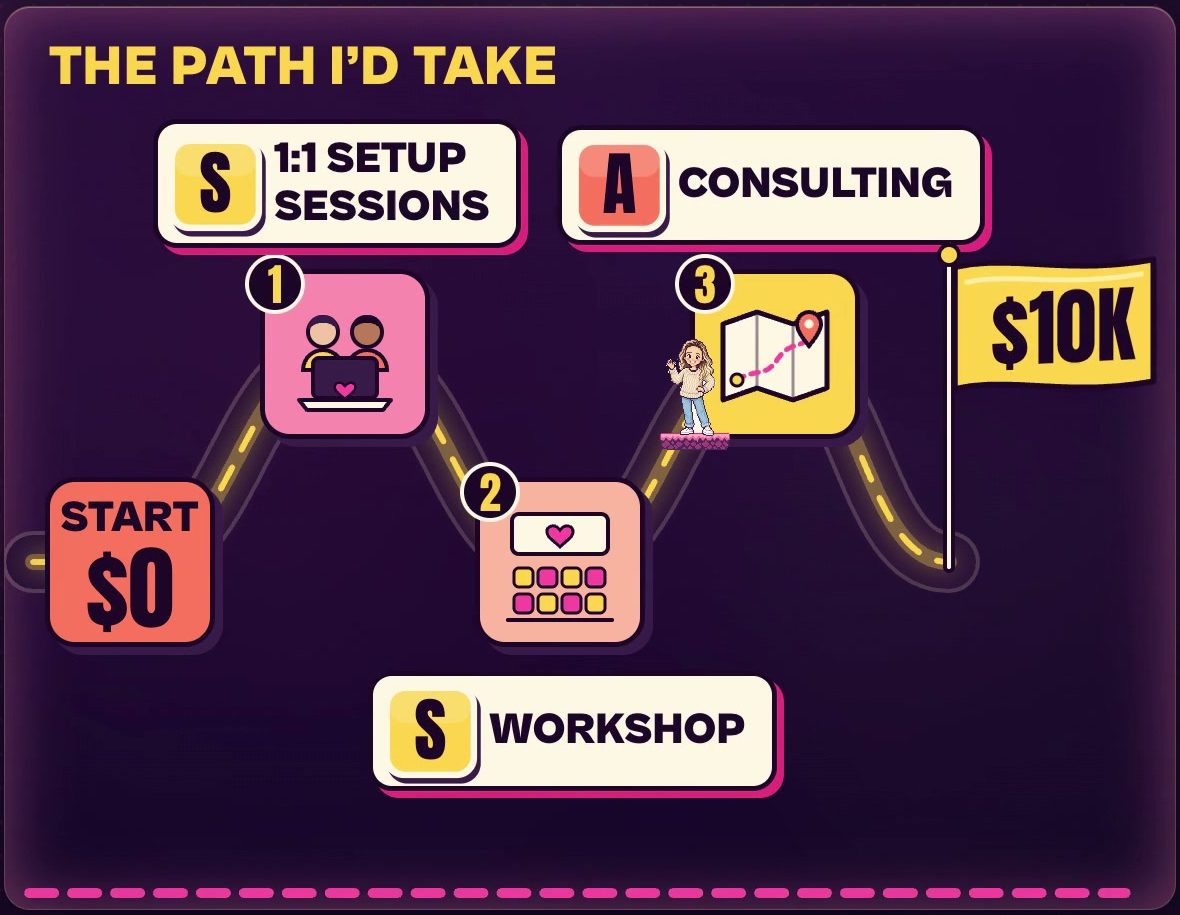
- Start with 1:1 AI setup sessions, so you get paid this month and learn what people are actually getting stuck on. We're in a bubble. You're obviously interested in AI (that's why you're reading this), so you assume everyone is miles ahead. Then you sit with real business owners and realise they're only just getting started.
- Turn that into a workshop. It's a group version of your 1:1 session.
- Offer consulting after that, to the people who put their hand up.
The whole time, post content as you go. Build a personal brand alongside whatever you choose, because instead of reaching out to people for work, the work starts coming to you.
I posted content all through 2025, and at the start of 2026 I still only had 2,000 followers on Instagram. But I had a successful six-figure business, and all of my clients were inbound. They were asking to work with me, or signing up to my workshops, where I pitched them at the end.
For the longer version of why the order matters, read why the order is what makes you money with Claude.
FAQ
What's the fastest way to make money with AI as a beginner?
1:1 AI setup sessions. You don't need an audience or a website, just a little more AI know-how than the person you're helping and five business owners you already know to message. Workshops are just as fast once you have a group to teach.
Do I need an audience to make money with AI?
Not for the top three on this list. Setup sessions and workshops can start with warm outreach and the groups you're already part of, and consulting clients usually come out of those workshops. Courses, a paid community, brand deals and your own app all rely on an audience, which is why they sit lower for beginners.
Is an AI automation agency still worth starting?
It's C tier on my list. Clients often can't tell you what to automate, their systems are messy, automations break at night and building is getting cheaper, so clients expect to pay less. If you still want to do it, productise it: one industry, one automation, sold over and over, with a retainer for when it breaks.
Learn the workshop and consulting paths inside Wright Mode
This is the path I teach inside Wright Mode, my AI membership for women in business. There's a workshop path that takes you from your first booking right through to running the sessions, an AI consulting path, and my full content system and video editing skills. More than 230 women are already in there doing this stuff.