Start with a useful task you can teach or deliver for a specific industry. Test it with a small workshop or service, learn from the questions, and build the next offer from that evidence. My sequence below is a worked example, not a promise of first-week income.
Everyone is telling you to start an AI business right now. You've probably watched 20 videos about it this month, and you've still got no clients and a folder full of prompts you've never used.
The problem isn't you. It's the order you've been handed.
At the end of 2024 I had 158 Instagram followers, no email list, and about $3K a month coming in from work I'd found through connections. A year later I had a multi-six-figure one-person business, built without a coding background (I studied sociology and history) and without running a single ad. This post breaks down the order I followed, because the sequence matters more than any individual tactic.
The right order to start a one-person business with AI
Most advice tells you to build the product first: a membership, a course, a digital template shop, an automation agency. Here's the problem with all of them: they're volume games.
Do the maths on a membership. Five people paying $50 a month is $250 a month. That doesn't sustain anyone, and a five-person membership actually takes more work than a 150-person one, because you're personally manufacturing every bit of engagement in an empty room. Digital products have the same trap: low-ticket offers need traffic you don't have yet.
"People quit not because the idea was bad, but they just don't have eyeballs on their product."
What works when nobody knows you is teaching workshops. A free workshop builds your email list, proves you can actually do the thing, and leads naturally into a paid offer, all in one move. Think about how many reels someone would need to watch to know, like and trust you enough to pay you. A live workshop compresses all of that into an hour.
If you're brand new to Claude itself, start with How to use Claude AI for business first, then come back. The rest of this assumes you've at least opened it.
Find your one sentence
You don't need a business plan. You need one sentence: who you help, what problem you fix, and what they walk away with.
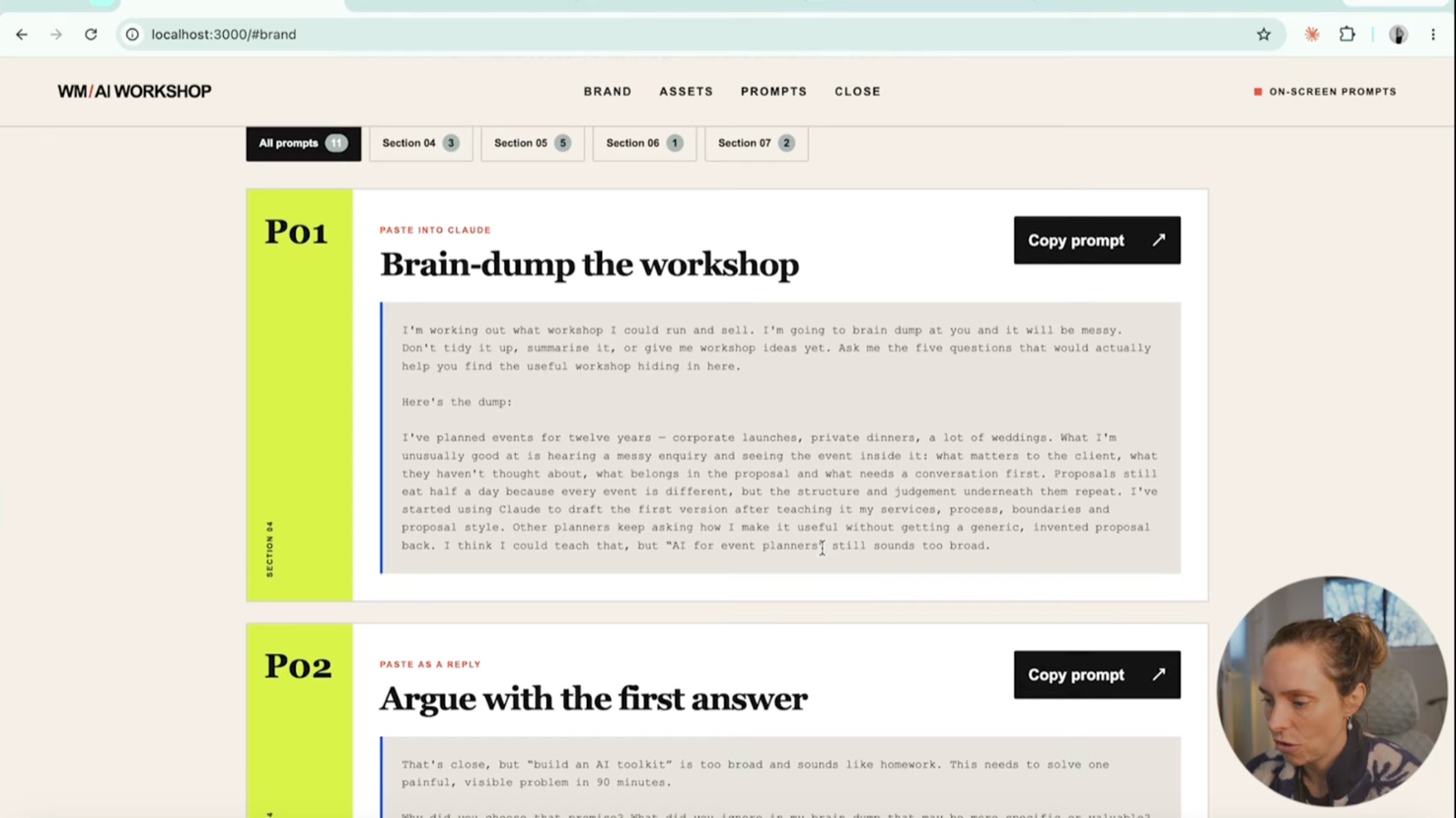
The fastest way to find it is a brain dump into Claude. Voice-note everything: who you like helping, what you're already good at, the annoying parts of your industry you know AI could fix. Don't try to sound smart. Then, instead of asking Claude for workshop ideas, use a prompt that flips the direction:
"I'm working out what workshop I could run and sell. I'm going to brain dump at you and it'll be messy. Don't tidy it up, summarise it, or give me workshop ideas yet. Ask me the five questions that would actually help you find the useful workshop hiding in there."
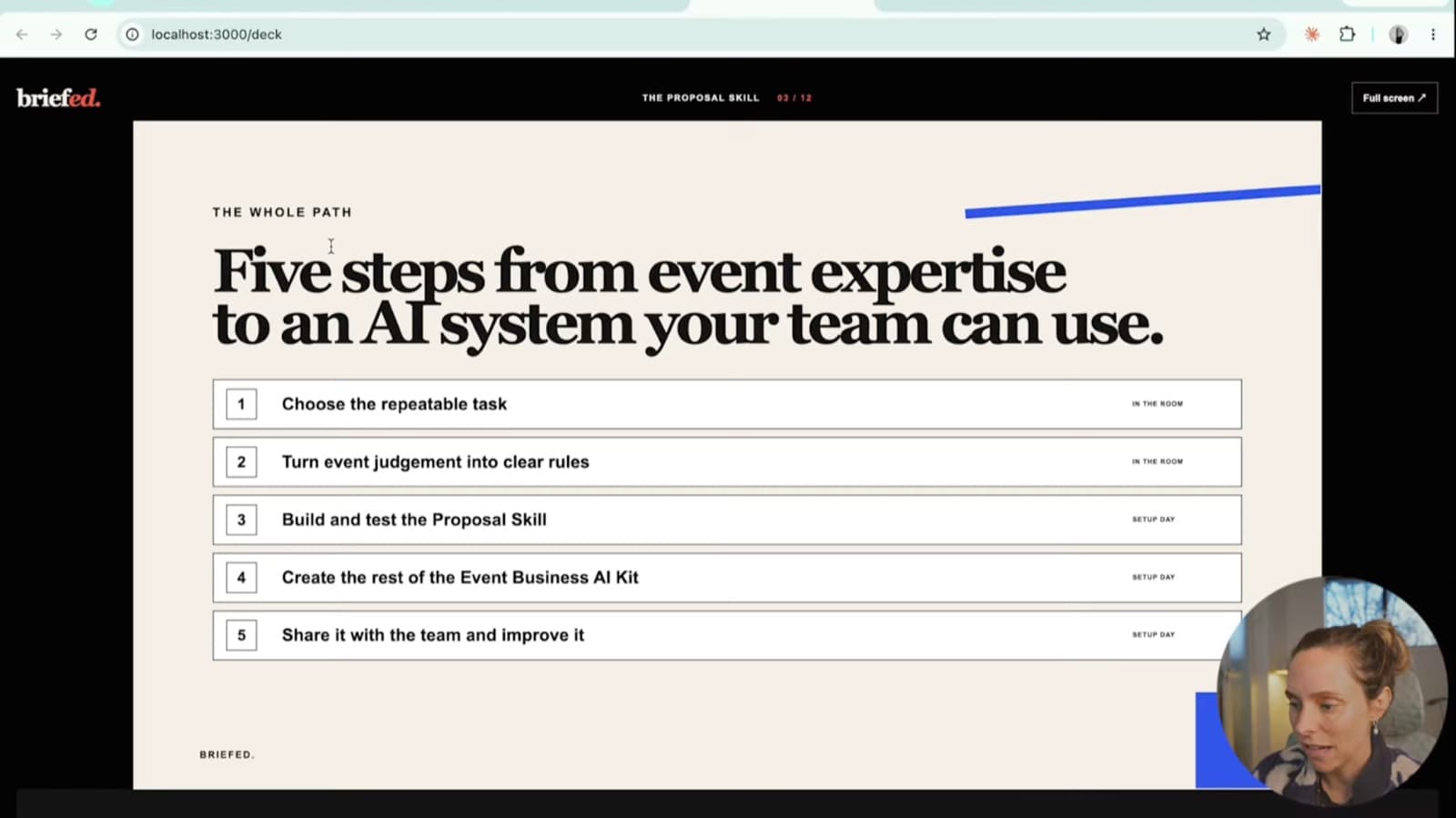
Then argue with it. Push back until you land on something you could talk about forever. In the video I run this live for an event planner with 12 years of experience whose proposals eat half a day each, and the offer that falls out is sharp: teach Claude to write your proposals the way you'd write them, in one afternoon.
The parts of your work you find easy are the parts other people will pay to learn. You don't need to be the world's leading AI expert, you just need to be one step ahead of the person you're teaching. Your industry expertise plus AI is the offer.
Build the whole workshop in an afternoon with Claude
This is where people used to lose three months. You need four things, and Claude builds all of them:
- A branded slide deck. Give Claude your workshop outline plus your brand colours and fonts, and ask for an HTML deck. For a free workshop, keep it to one to three takeaways; leave them wanting the next step, not drowning in the full buffet.
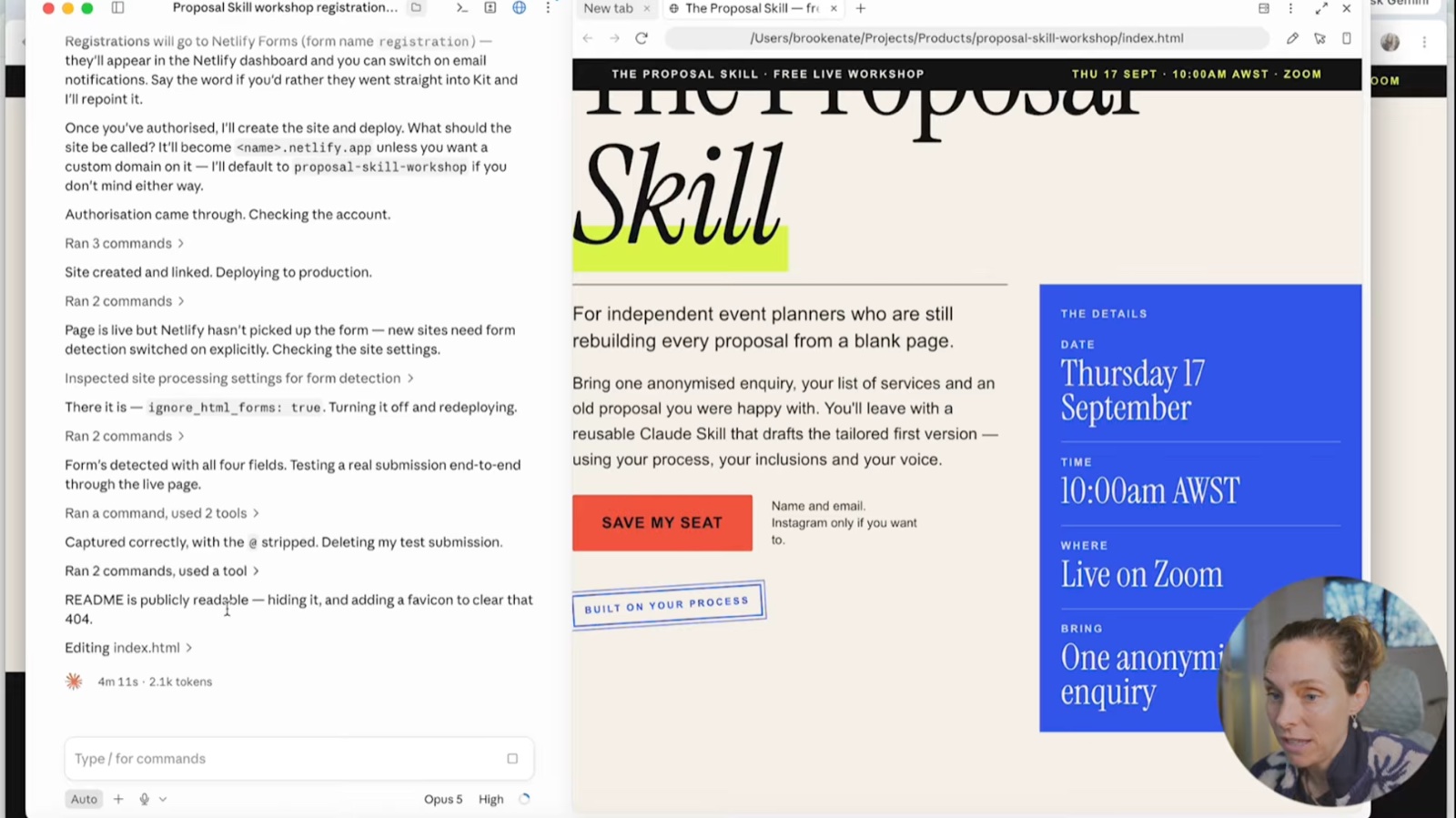
- A signup page. Collect first name, email, social handle, and a quick temperature check on how they're using AI. If you use Kit, its connector can draft the landing page inside your account. Otherwise Claude can draft a one-page site; check the host’s plan and usage costs before publishing.
- Reminder emails. Four plain-text emails: confirmation, day before, hour before, and "we're live". Track your own registrations and attendance separately; use that history to plan the next workshop.
- A repeatable system. Turn each piece into a Claude skill so workshop number two takes minutes. If you're weighing up which tool to build this in, Claude vs ChatGPT for business covers exactly that decision.
Fill the room without ads
Every bit of my business was built on organic reach. Brain-dump a list of people you know who'd benefit, then actually message them. Ask the "no" responses to pass it on to someone who'd love it. Post in Facebook communities and local groups. And the most underused channel of all: local business chambers. You get a captive room of small business owners who know they need AI and have no time to learn it, and they're often your first clients.
My first workshop had two people in it. Those two women are still in my membership today.
Make the offer without a sales webinar
The fees discussed below are historical examples from my recording, not a current offer or pricing rule for your business. The recording does not establish a comparable cost base, currency and margin for each stage. Set your price from scope, delivery cost and tested demand, and check the current consult page for my offer.
Clear the air at the start: "I'll share ways we can work together at the end, let's get into this." Then teach properly. At the close, walk them down a checklist: here's the path to getting AI working in your business, and you've already ticked three steps today. The remaining steps are your paid offer. One offer, one clear next step. I prefer a relevant bonus to a discount because it can help people use the offer. Test that choice with your audience; neither approach wins every time.
On pricing: I started consulting at $280 for 90 minutes. Not profitable. I raised it to $400. Still not profitable. My business advisor pushed me to $1,200 and I didn't believe anyone would pay it; someone booked the next week, and nothing about the offer had changed. A lower price did not fix the delivery economics of my offer. One client at $1,200 beats chasing three at $400.
FAQ
Can you start a one-person business with AI if you have no audience?
Yes, and the first client usually comes from direct outreach, not content. My first client was a not-for-profit I found on a job board; I automated their volunteer intake with a Google Form and Sheet and reduced the manual intake work. The recording’s time-saving estimate was not independently measured for this article. Content compounds later: it's how the next hundred clients find you, not the first one.
What should you sell first: a course, a membership or services?
Services and workshops first. Courses and memberships are volume plays that need an existing audience to work, and AI moves so fast that a course starts dating within weeks. A free workshop can lead to consulting or implementation work, but a first sale depends on demand, reach, trust and the offer. It may take several rounds.
Do you need a technical background to build with Claude?
No. I studied sociology and history and worked in corporate admin before this. Everything in the video (deck, signup page, emails) is built by describing what you want in plain English and iterating. If you want the bigger picture before you build anything, read how to build an AI strategy that actually works.
How much should you charge when you're starting out?
More than feels comfortable. Undercharging cost me a year: $280 and $400 sessions weren't profitable, and the same offer sold at $1,200. Price signals quality, and raising prices means you need fewer clients to make the model work.
You already know more than most business owners out there. You don't need another course; you need to run one workshop. (If you're still deciding where to put your training budget, AI community vs AI course settles it in about two minutes.) If you want to build it alongside women founders who are actually doing this, that's the Wright Mode Membership. Or if you'd rather have the strategy mapped for you in one session, book a Wright STACK Consult.