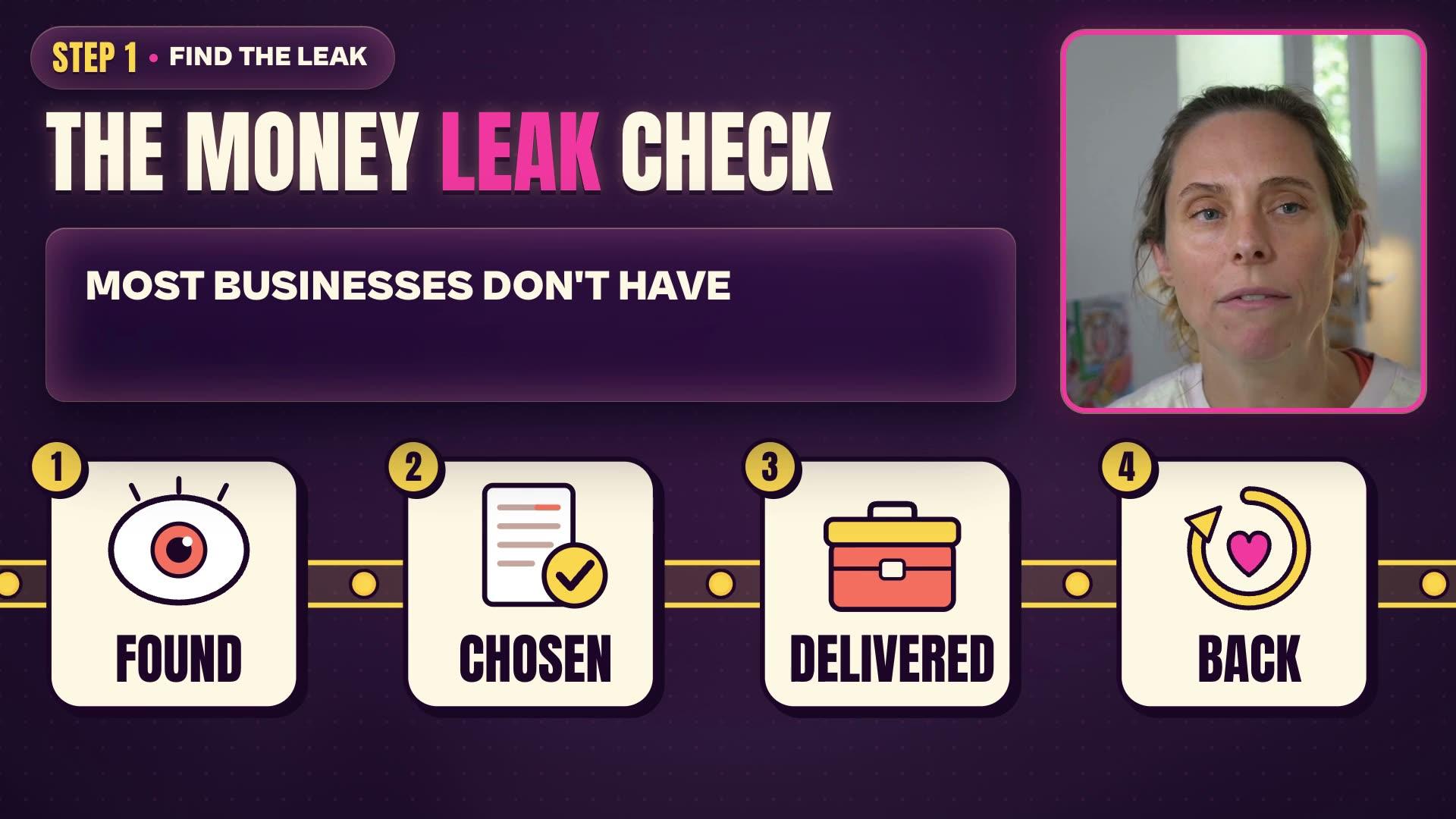
To find the AI opportunities a business will actually pay for, find where it's losing money first, then use AI on that one spot. I do it with four questions, in order: are enough people finding the business, do they say yes, can it deliver the work and get paid, and do customers come back? Fix the first one that's broken. Everything else can wait.
Most people trying to sell AI to businesses start with the tools. The ones who get paid start with the leak. And if you've spent years in one industry, you already know where those businesses usually leak, which is a head start most "AI people" don't have.
The video below is the full walkthrough: what an AI consultant actually does, my six steps, the Money Leak Check, a worked example with an electrician, and the four mistakes I see all the time.
What does an AI consultant actually do?
An AI consultant sits down with a business owner (and sometimes a few people from their team), works out which jobs in the business AI could do or speed up, helps them put that in place, and gets paid for it. It isn't knowing every tool or building automations all day.
There's a lot of demand for this right now. Almost every business owner has heard that AI can help their business. Most haven't done anything about it, because they haven't had the time or don't know where to start. They know something isn't working. They have no idea what the solution looks like.
That gap is the job.
Why your industry experience is the head start
If you've run the office for a trade business, worked in a salon, done the books for other people, or worked in weddings or hospitality, you already know how those businesses make money. You know where they get stuck, and you speak their language.
Someone who's just good with ChatGPT has to learn all of that from scratch. You don't.
It also changes the questions you ask. On a quoting problem, someone who knows the trade will ask things an outsider wouldn't think of, like whether customers are getting other quotes while they wait, or what has to happen at the site visit. If you're still working out how to turn that knowledge into an offer, how to become an AI consultant with no tech background covers the path I took.
The 6 steps (only one of them is building)
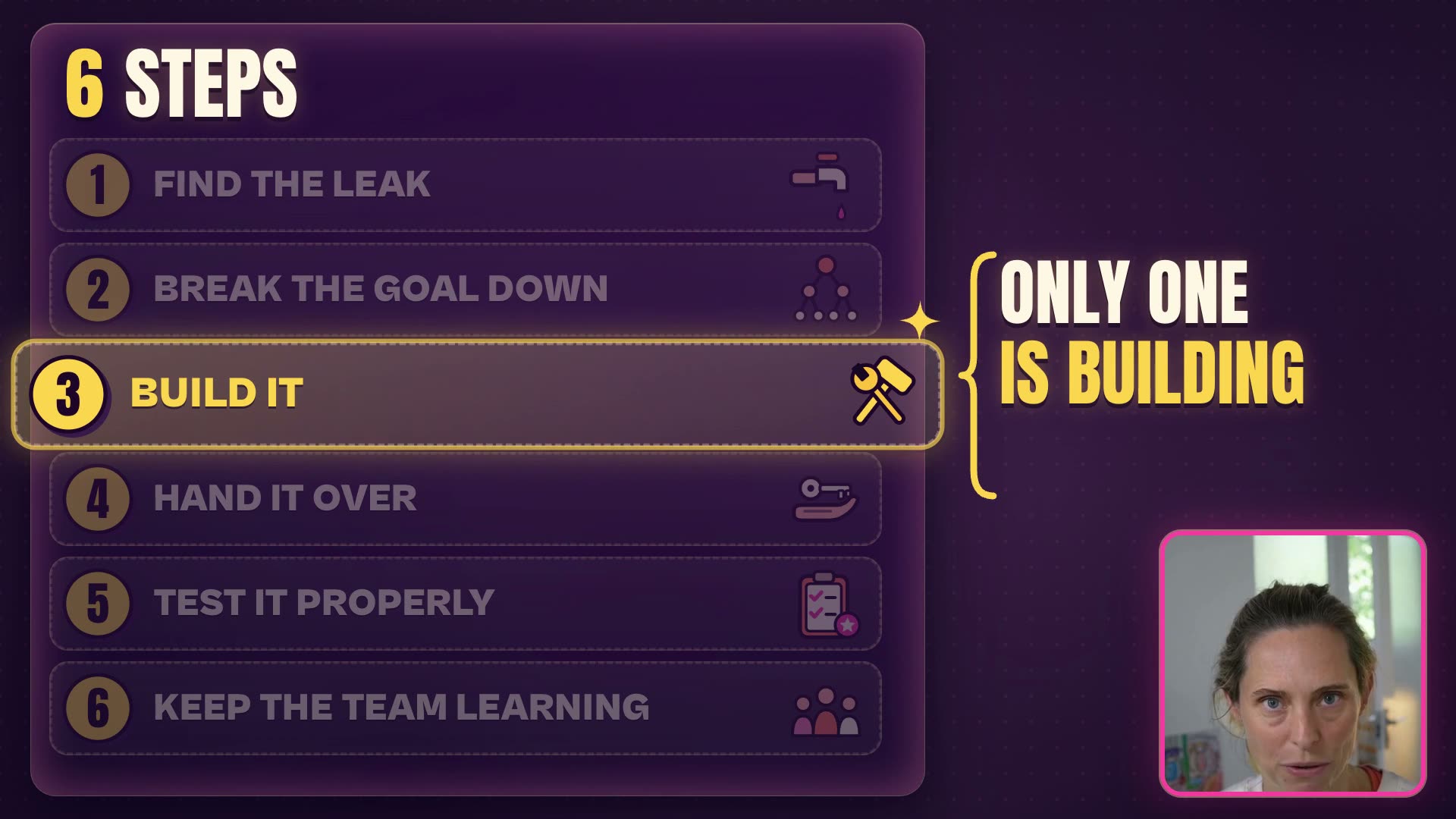
- Find the leak. Where is the business actually losing money?
- Break the goal down into small, specific actions.
- Build the thing that fixes it.
- Hand it over so the business owns it.
- Test it properly.
- Keep the team learning.
Only one of those six is building with AI. A lot of people think they can't do this because they don't know how to build AI agents or complicated automations. But building is one sixth of the work. The rest is asking good questions, thinking clearly and knowing the industry. Claude or ChatGPT does most of the heavy lifting on the build now anyway.
Step 1: find the leak with the Money Leak Check
There's an old idea in business that a business can only move as fast as its slowest step. Speed up the slowest step and everything gets faster. Speed up anything else and almost nothing changes.
I see this so often: people want AI in a part of the business where it won't make any difference. Say a business gets heaps of enquiries but takes three days to reply. Those enquiries sit in the inbox going cold. The best marketing in the world won't fix that. More enquiries just means more people waiting three days.
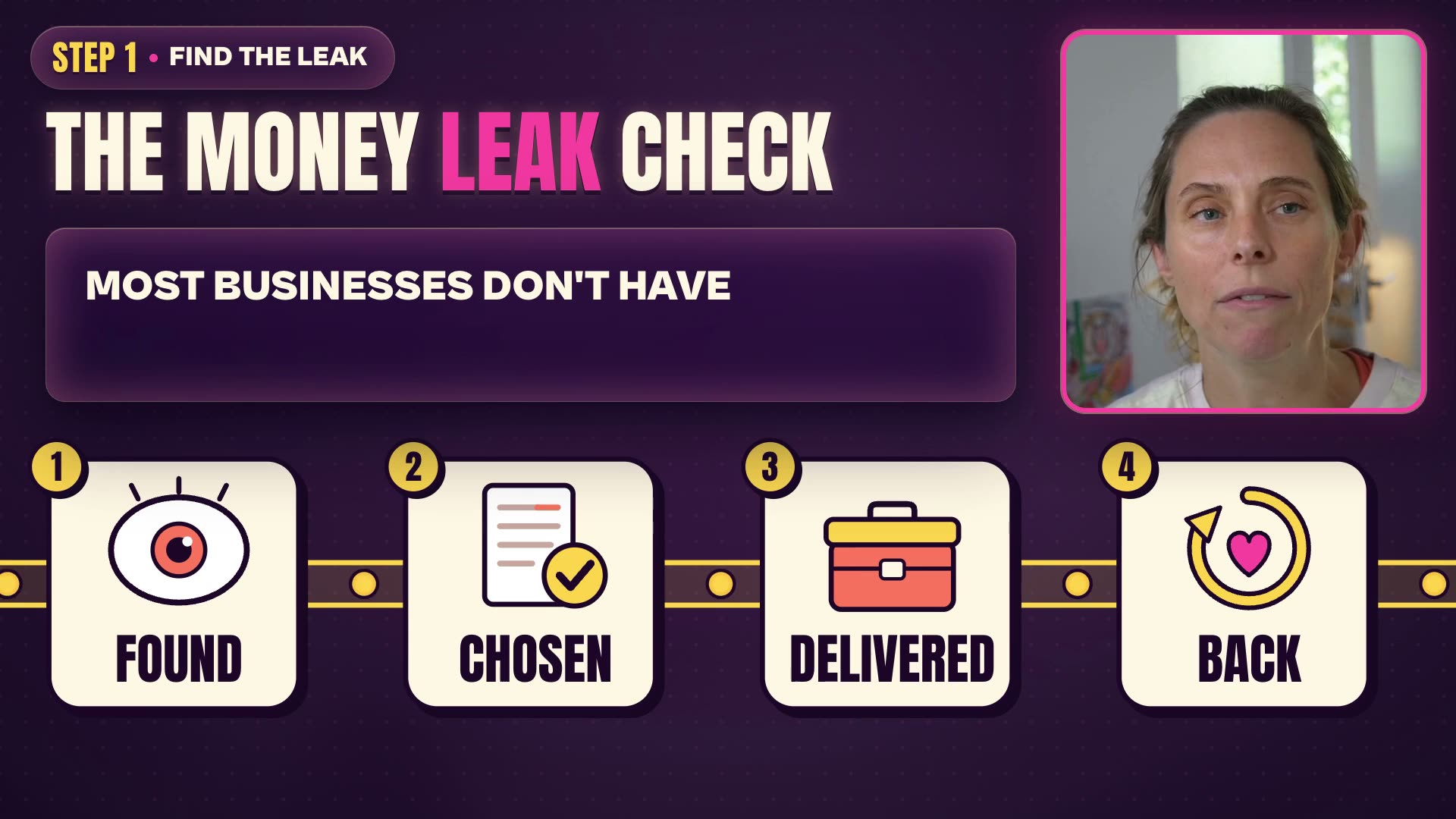
The Money Leak Check is four questions, asked in this order:
- Found. Are enough people finding the business? (Are there enough eyeballs on it?)
- Chosen. When people find them, do they actually say yes?
- Delivered. Can they do the work and get paid for it without drowning?
- Back. Do customers come back, or send their friends?
Then you fix the first one that's broken.
Most of the time the leak is at the front, in Found or Chosen. Most businesses don't have a delivery problem, even if they like to think they do. They just don't have enough coming in for delivery to ever be the problem.
On your calls, don't guess. Go through the four questions one at a time and ask for numbers.
When the leak isn't where they think
It's not always at the front, and this is where people go wrong.
I've been flown in to work with companies in person. With one of them, the conversation going in was all about marketing: more leads, getting their name out there. When I actually sat down with the business owner, the real problem was their reporting. They had big tender jobs, and if they don't report on the work, they don't get paid. Their reporting was taking weeks, because of all the different details each report needed.
The money was already earned. It was stuck behind reports.
So the reporting was what needed speeding up. If I'd done what they asked for, we'd have built AI marketing tools and pushed more work into a business that was already struggling to get paid for the work it had. The other thing we did was build an AI quoting tool, so they could reply to their leads faster. None of it was marketing.
A worked example: the electrician who asked for more leads
An electrician books a call with you and says, "I need more leads." Start at Found.
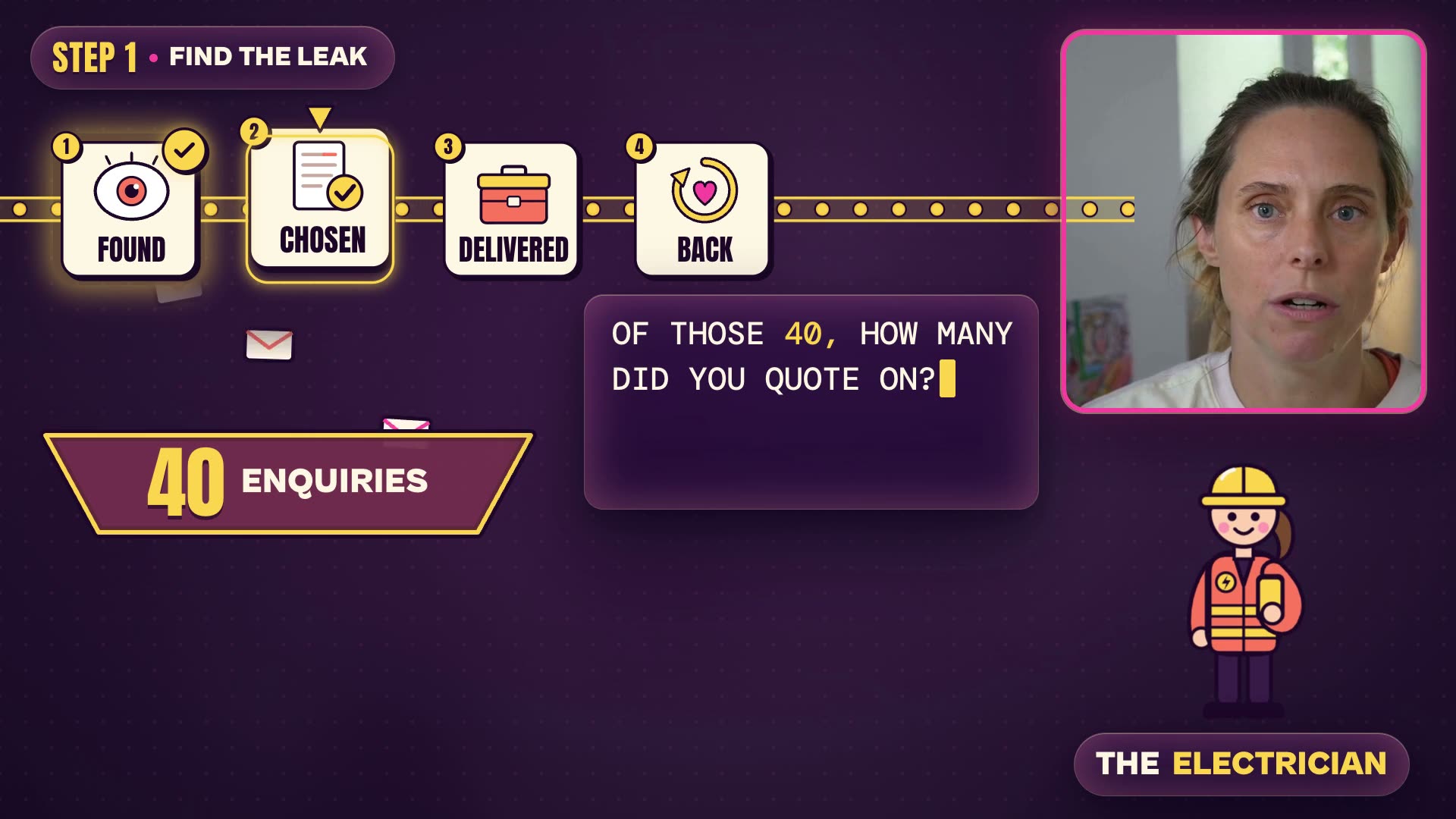
Found. How many enquiries came in last month? About 40. That's not nothing. People are finding her, so Found probably isn't the leak.
Chosen. Of those 40, how many did you quote on, and how many turned into paid jobs? She quoted 20, and eight went ahead. Now it gets interesting. Why didn't the other 12?
That's where it comes out. Her quotes take about a week to go out. She does them at night after a full day on the tools, and sometimes she forgets, because it's not a priority when she's tired. The measurements are in a notebook, the photos are on her phone, and half the details are in her head. By the time the quote lands, the customer has gone with someone who replied faster.
That's the bottleneck. I'd still check Back (do people use her again, do they refer her?). If the answer is "always, heaps", that's not the leak either.
So from that point on, every conversation about where AI fits is about the quotes: getting them out faster, following them up, making it clearer what's included, and standardising her quoting so AI can help. More leads would have made it worse. More quotes is what she can't get out.
Step 2: break the goal down
This sounds fancy. It isn't. Take the goal and ask, "How would we do that?" Then take each answer and ask the same thing again, until you hit small, specific actions someone can actually do.
For the electrician, the goal is more quotes turning into more jobs. How? Get quotes out faster, follow up the ones that go quiet, and make it clearer what's included.
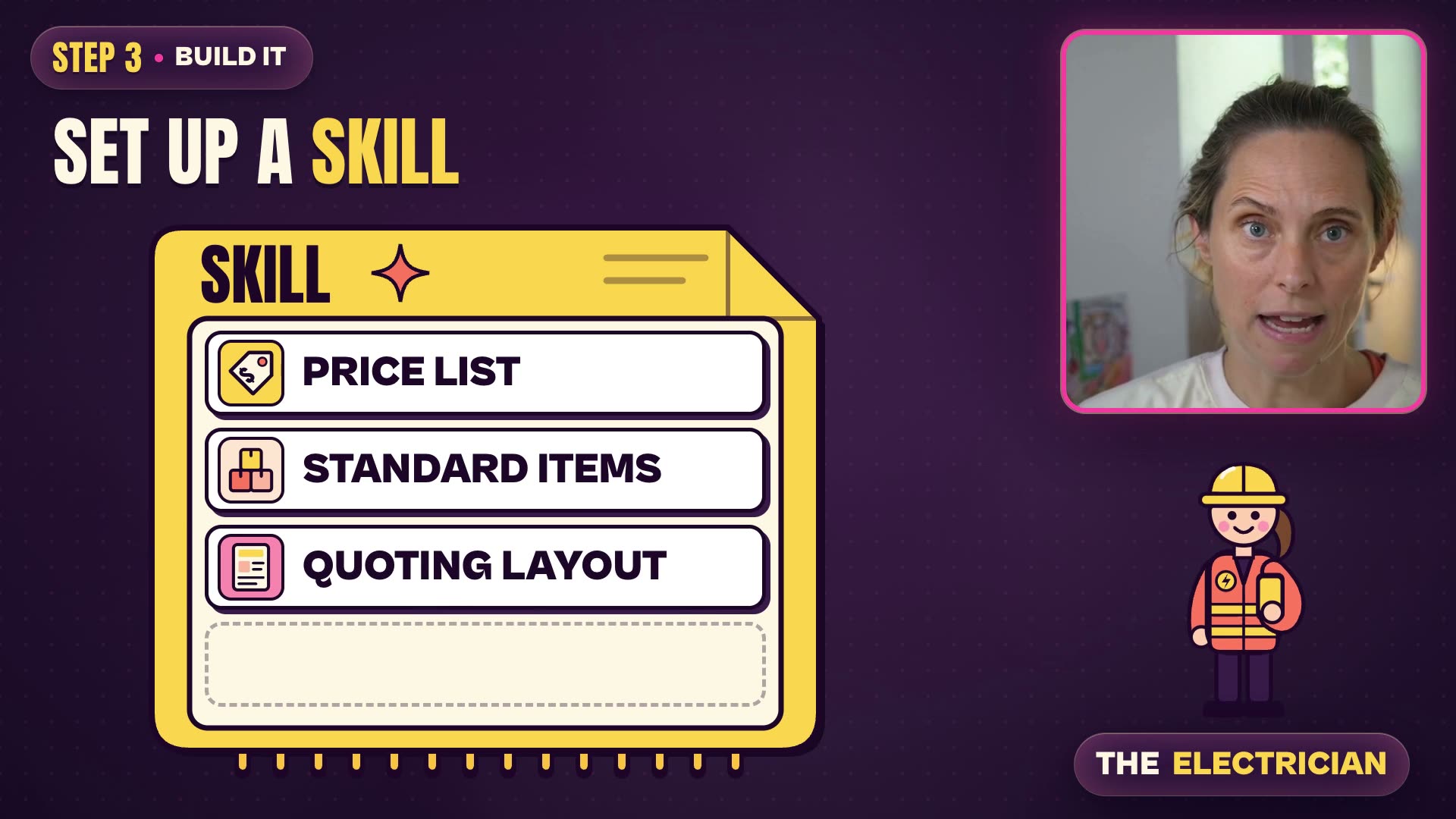
Take the first one. How do we get quotes out faster? An AI skill that keeps her standard items and prices in one place, uses the same layout every time, and drafts the quote from her site notes. She records a quick voice note on site, sends it with the photos, and it turns them into a first draft. She checks it lines up and sends it. That's 80% of the quoting done.
Some of the actions on your list are perfect for AI. Some aren't: she still has to do the site visit, and the follow-up phone call is still her picking up the phone.
Then take the whole list into Claude or ChatGPT: here's the business, here's the goal, here's the breakdown, help me plan how AI can help. That's maybe 15 minutes of proper thinking, before you jump to a tool.
Step 3: build it
This is the bit most people are scared of, and it's the smallest part of the whole process.
For the electrician: set up a skill with her price list, her standard items, her quoting layout and a couple of her best past quotes. When an enquiry lands, she sends it a voice note and the site photos. It writes the draft from the enquiry, the voice note and the photos. She checks the scope, sets the price, and it goes out the same day.
For follow-ups, keep a list of the quotes that have gone out. A scheduled task can check each one (has the customer replied? has the job gone ahead?) and draft a friendly follow-up when the answer is no.
That's the build. A business doesn't pay you for this because it's complicated. It pays you because you're outside the business. The owner is in it every day, and it's really hard to step back and see where the money is going. You can walk in and see it straight away, especially when you know the industry.
Step 4: hand it over
This is the part I care about most.
A lot of people get asked, "Can you just build it for me?" They say yes, and then they're the person the client calls every time something breaks, particularly with sole traders and small teams. I don't love building for other people anymore. When you build it and keep the keys, they never learn how it works, and you've capped how far you can grow.
I worked with a company recently that had been burnt by consultants who set things up and walked away. So the whole point was that their team could run it after I left.
- Set things up in your client's own account, not yours. (If you're building skills, you can build them in yours and pass them over.)
- Teach whoever does the job, say the quotes, how to use it, how to install skills and how to create new ones.
- Write the steps down so they don't live in your head.
- Build up a set of simple resources (what a skill is, how to install one) that you can give every client.
Then you can tell them you're making their team more capable, not dependent on you. They love that.
Step 5: test it properly
AI doesn't give you the same answer every time. Run it once and you might get a great quote. Run it five more times and two of them might be a mess.
So test on a batch. Grab 10 old jobs the electrician has already quoted, run each one through, and score every draft out of 10. Throw in tricky ones: a straightforward job, one that's missing information, one that's outside the work she normally does. Then check:
- Does it make up prices?
- Does it ask for the missing details?
- Can she check it without rewriting the whole thing?
When you change the instructions, run the same 10 again, so you know it got better instead of hoping it did. The technical term for this is evals. That's all it is.
Step 6: keep the team learning
Once a few people are using it, some will get much better results than others. Some people are just naturally better at AI.
Set up short weekly catch-ups where people share what's working. Take what those AI champions are doing and make it the way everyone in the company works. You don't need to be in those meetings. You need to encourage them.
Then check the Money Leak Check again. Once the electrician's quotes are flying out, she can take on more work, and the leak moves, maybe to Found or to Delivered. That's where ongoing work comes from: not because they need you to press the buttons, but because there's always a next leak.
4 mistakes I see all the time
- Fixing something that isn't a leak. Someone sets up AI for a business's admin, and the business has half-empty books. Saving two hours on admin doesn't make them a cent. If it doesn't touch one of the four leaks, step back and look for where the money actually is.
- Inventing brand new systems. Improve something the business already does, like its quotes or its follow-ups. Don't build elaborate systems they've never had and are never going to use. This is one of the biggest mistakes, and it will stop you getting ongoing work.
- Not measuring. Get the numbers on the first call. How long does a quote take? How many go out a month? How much is being quoted each month? Without a starting number, you can't show the client what you've changed, and two months in they'll be wondering whether they still need you.
- Giving it all away for free. This was me.
Stop giving it away: $280 to $3,000
I used to do free discovery calls. I'd jump on, ask all these questions, find the issues and basically tell them exactly what I'd do. And nobody booked a paid thing. Why would they? They'd just had a free consulting call.
I worked with a business mentor who told me to raise my prices, which honestly I needed to hear, and she stopped me doing free calls. Now the call is the product. It's a paid consulting call: people book, pay straight away, then pick a time in my calendar.
My first consulting call was $280. Then it went up to $1,200. Now it's $3,000. Same questions. I just stopped giving them away. What actually happens on that call is in how to run an AI consulting call.
Where do AI consulting clients come from?
For me, free workshops. Teach one genuinely useful thing for your industry, even just AI fundamentals and how they apply. Some people will want to do it themselves. Some will want to work with you one on one, and that's where you share your booking link so they can book and pay. The full workshop system is in how to run an AI workshop and get clients from it.
The tools will keep changing. Every week there's something new. This doesn't change: find the leak, break it down, build it (or help them build it), hand it over, test it, and keep the team learning.
Try this in 15 minutes
Pick a type of business in the industry you already know. Write down how you'd answer the four questions for a typical one:
- Are they being found?
- Is that turning into work?
- Can they deliver that work and get paid?
- Do people come back?
The first "no" is your leak. Find the first leak and that's your offer right there.
Quick answers
Do I need to be technical to sell AI consulting?
No. Building is one of six steps, and Claude or ChatGPT does most of the heavy lifting on it. The parts clients pay for are the questions, the thinking and your knowledge of their industry.
What if the client is sure their problem is marketing?
Run the four questions anyway and ask for numbers at each one. If plenty of people are finding them and saying yes, more marketing just pushes more work into the real bottleneck.
Should I build the AI system for the client?
You can build the first version, but set it up in their own account and teach their team to run it. If you keep the keys, they never learn how it works and you become the person they ring every time something breaks.
Should I offer free discovery calls?
I don't anymore. When I did, I gave away the diagnosis and nobody booked a paid session. Now the consulting call is the paid product.
Turn your leak into a paid offer
I run a paid AI membership, so I have an obvious interest here. If you want help turning the leak you found into an actual paid offer, with the price, the booking page and the workshop that fills it, that's what we work on inside Wright Mode. Members bring their offer to the monthly Build with Brooke and the fortnightly Co-Work + Q&A, alongside other women doing the same thing.