Sandy’s AI content system has three jobs: find promising topics, draft scripts using her own frameworks, and prepare videos for batch filming. Her industry experience supplies the judgement. The reported income below combines business streams and salary; it is not a measure of what the AI earned.
Sandy Lee got let go with no warning. Company restructure, one meeting, done — and she was the only salesperson bringing in revenue.
That was the moment she decided nobody else would ever hold her income basket again.
"I'm never going to have somebody hold my income basket anymore. That is one of the most unsustainable and unpeaceful way to live my life."
Fast-forward to now: she has an AI content system that runs around a full-time job and three kids under the age of eight. Her new YouTube channel hit 67,000 subscribers in roughly seven months. In the interview, she reported $52,000 in combined income for July 2026, including her full-time salary.
I sat down with Sandy for a full episode and made her break down the whole thing — the system, the strategy, and every dollar of that $52K.
What an AI content system actually looks like
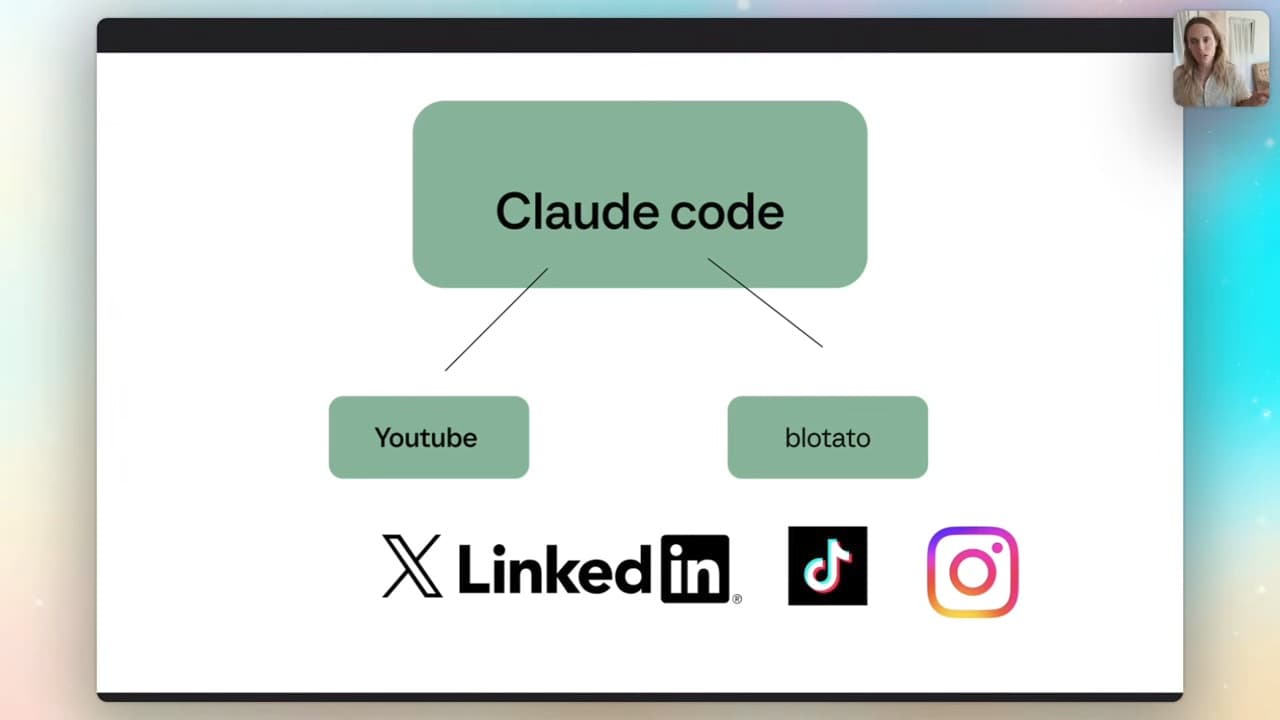
An AI content system is a repeatable pipeline that uses AI for the heavy lifting at each stage of content creation — finding proven ideas, writing scripts, and packaging videos — so the human only does the parts that need a human. Sandy built hers with Claude Code, then turned it into an app (Slee Studio) because people kept asking for it.
Hers has three stages:
- Ideation — track a handful of channels in your niche and surface the outlier videos (the ones performing way above that channel's normal baseline) from the last 7 to 60 days.
- Scripting — feed the winning format into Claude with your own frameworks, then customise it with your experience and stories.
- Filming and publishing — word-for-word intro, bullet points for the body, batch filmed around the day job.
None of this requires a technical background. Sandy's degree is in political science and she spent 10+ years in sales and marketing. Her words, not mine:
"AI is not going to replace the skills that you have. You're going to apply the skills with AI to speed up the work you're doing."
She compares it to farming — the farmer with the tractor beats the farmer doing it by hand. Same field, same crop, wildly different output. Your existing skills are the farm. AI is the tractor.
What used to take her days now takes a couple of hours.
Copy what works before you get clever
This is the part most people skip, because it feels like cheating.
Sandy doesn't start from a blank page. Her system pulls outlier videos from channels in her niche — videos performing 2x, 5x, 10x above that channel's baseline — and studies the format: how long it is, the title pattern, the thumbnail style, the hook type.
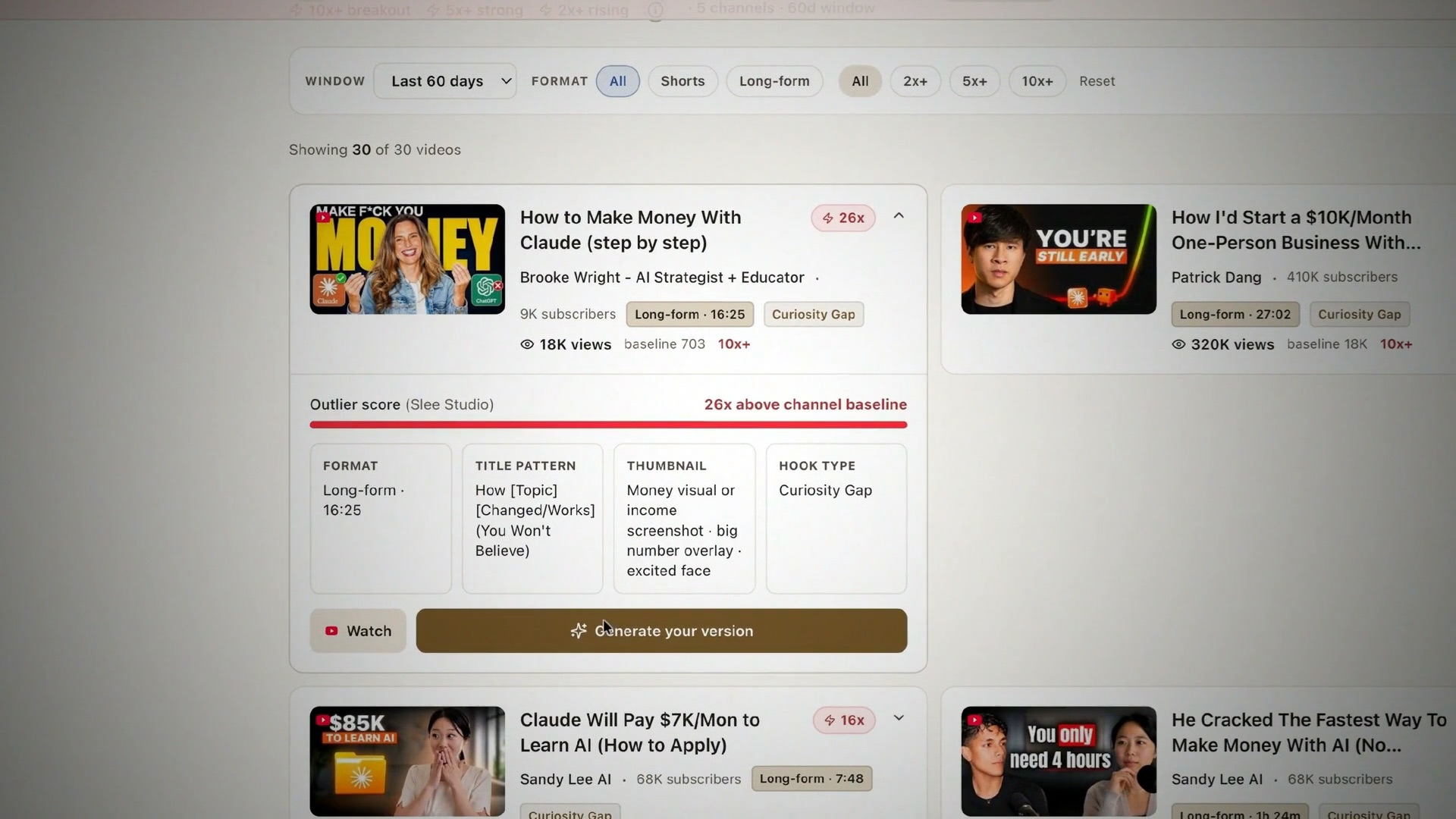
Then she recreates the format with her own story inside it. Not word-for-word copying — that's plagiarism and it doesn't work anyway. Format-level copying: the topic shape, the title pattern, the hook structure, filled with your experience.
One result she reported was an Instagram reel where she reused a hook from her own YouTube video — a strategy she picked up from another creator. That reel did 866,000 views and took her from 900 followers to 10,000 in two days.
The logic is straightforward: a proven idea already has demand, and when your video is similar to something an audience already loves, you have a useful audience hypothesis to test. Once you have traction, then you layer in personal stories and original angles.
If the research side is where you get stuck, I've written about using NotebookLM for content creation — a free way to run the same competitor-study process before you ever open a scripting tool.
The three things that actually matter on YouTube
Sandy's ranked list, from the episode:
- Ideation. Picking a proven topic matters more than anything you do after. A brilliant video on an idea nobody wants still gets zero views.
- Thumbnail and title. They earn the click. She studies the patterns on outlier videos rather than guessing.
- The first 30 seconds. The intro has to pay off exactly what the thumbnail and title promised, or people leave.
For intros she uses a seven-step hook framework she reverse-engineered from big creators in her niche — pattern interrupts, a promise for staying to the end, the lot. The intro is scripted word-for-word; the rest of the video is bullet points so she still sounds like a person.
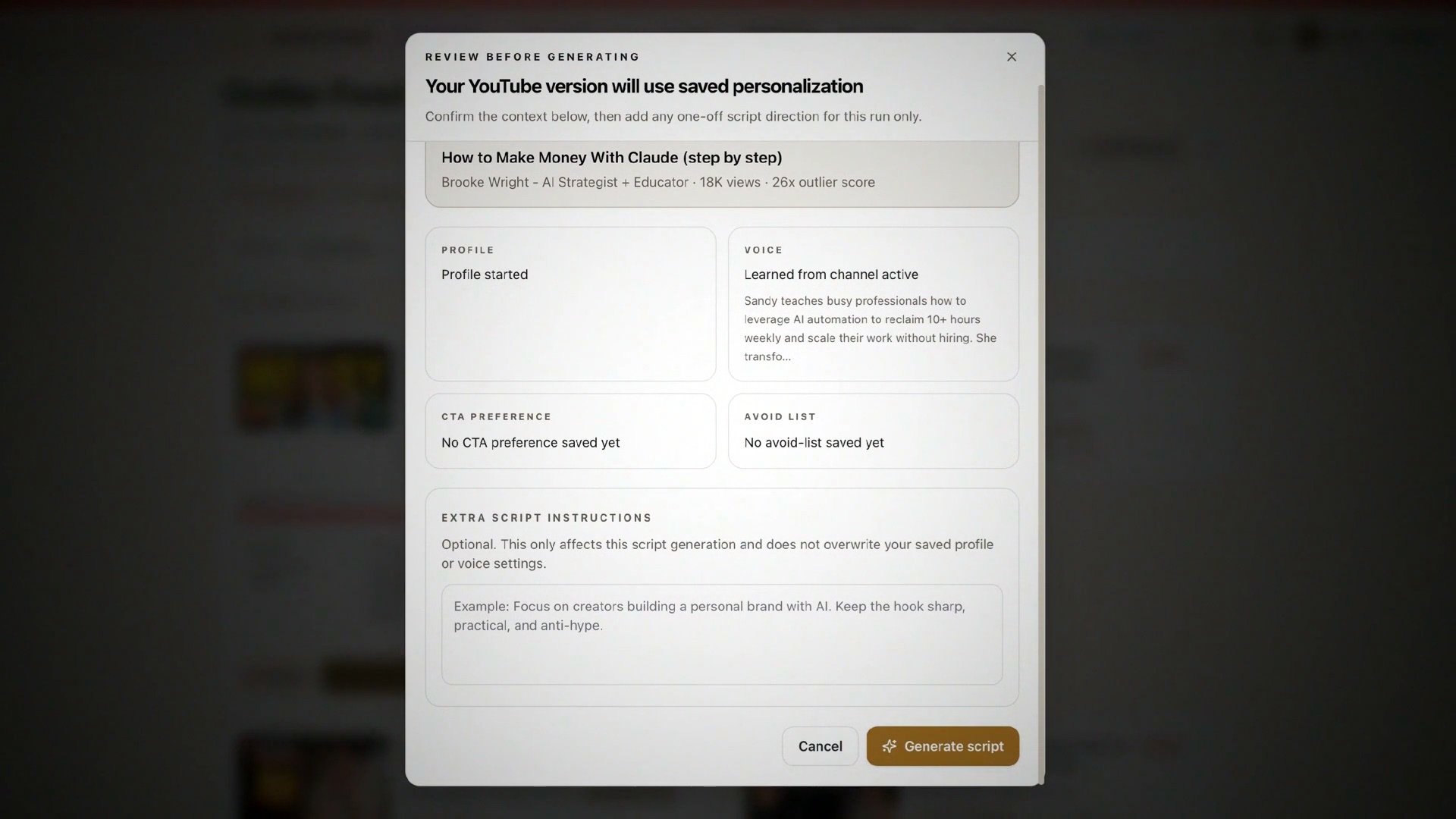
That's the detail I'd underline: she didn't ask Claude to "write a viral intro". She gave it a framework to execute. Vague prompt in, beige content out — the same reason the interview method beats asking ChatGPT for "10 content ideas".
The reported $52K combined-income month, broken down
Sandy shares her numbers publicly (her husband disagrees with this, she does it anyway) because income breakdowns are what motivated her when she started. So here's July, as she broke it down on the call:
- Sponsorships: $25,000 — brands paying to be featured on her channel
- Skool community: ~$10,000 — her AI Content Systems membership
- Slee Studio app: ~$2,000
- YouTube AdSense: ~$1,500
- Plus her full-time salary — because yes, she still has the day job
About $38,500 across the four listed business streams, plus salary in the reported $52,000 total. These are Sandy’s interview figures, not independently verified accounts. The interview breakdown reproduced here does not establish currency or net profit, so don’t treat the dollar amounts as AUD or as take-home business earnings.
Two things worth sitting with. First, AdSense is the smallest slice. People start YouTube channels thinking YouTube pays you — the real money is brands paying for access to the audience you've built. Sandy knows a creator earning a million dollars a year from sponsorship deals alone.
Second, this didn't start at $52K. Her first client came through Upwork — a $3,000/month SEO retainer she later raised to $5,500 by offering more. She built the delivery with Claude Code, and once it was set up, maintaining it took about five minutes a day. She eventually dropped client work entirely to put that time into her own audience, because client income is someone else holding your income basket too.
Don't just download Claude skills — read them
One thing Sandy teaches her community that I want to tattoo on the internet: downloading someone else's Claude skill without understanding it is like spending $500 on gaming gear when you don't know how to play the game.
Her fix is unglamorous and it works: open the skill's markdown file and read it line by line. When you know the skill checks Reddit, or calls vidIQ, you understand what Claude is actually doing — and you can build your next skill smarter. Fundamentals first, automation second.
Where to start: four questions before any tech
If all of this sounds great and you still don't know where to begin, Sandy's starting point has nothing to do with AI.
She uses the Ikigai framework — four questions, answered before you touch a single tool:
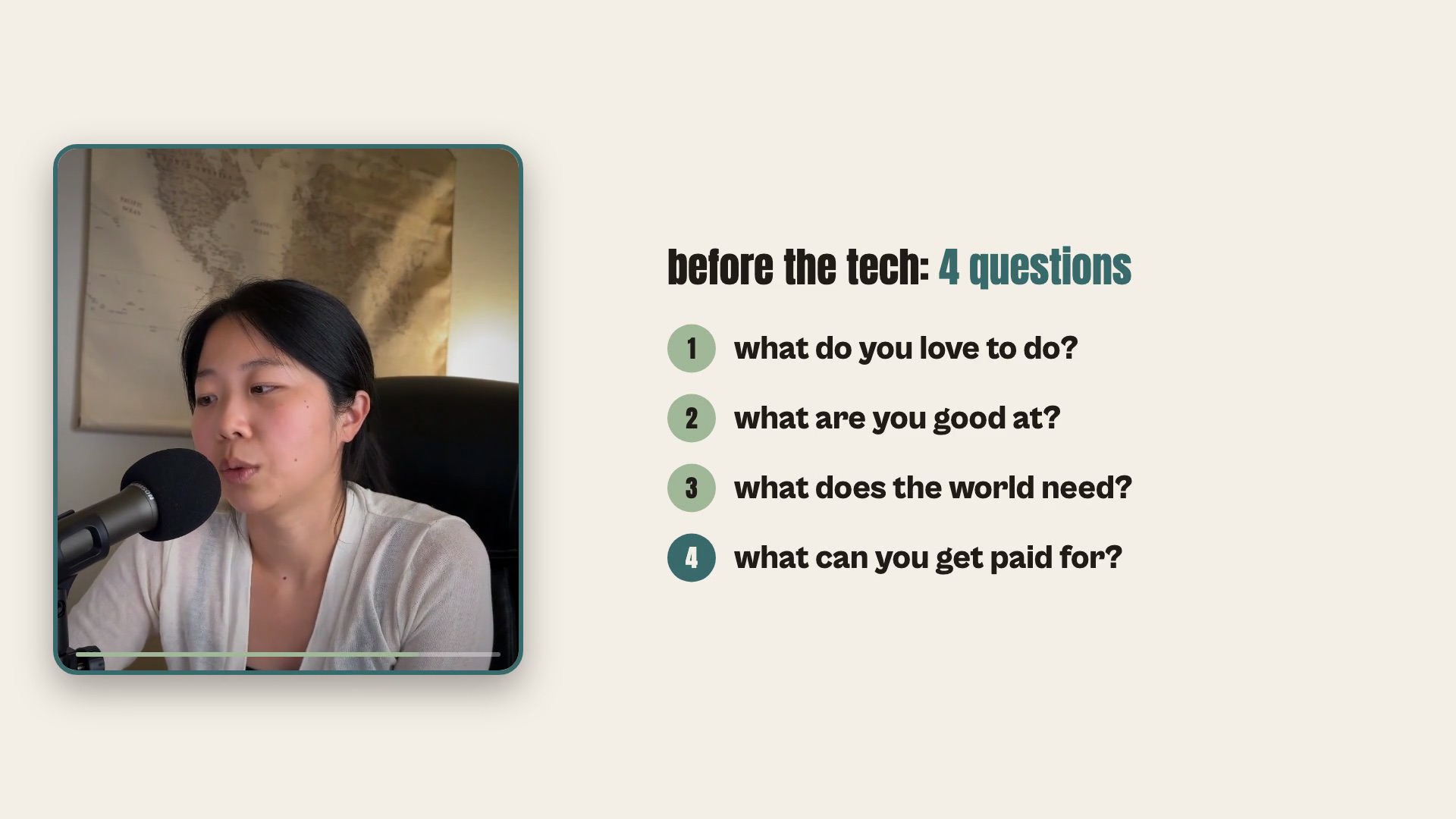
- What do you love to do?
- What are you good at?
- What does the world need?
- What can you get paid for?
And she's adamant about the method: pen and paper first. No AI. She filled a physical notebook with her answers, then dictated them into AI to summarise and turn into content pillars.
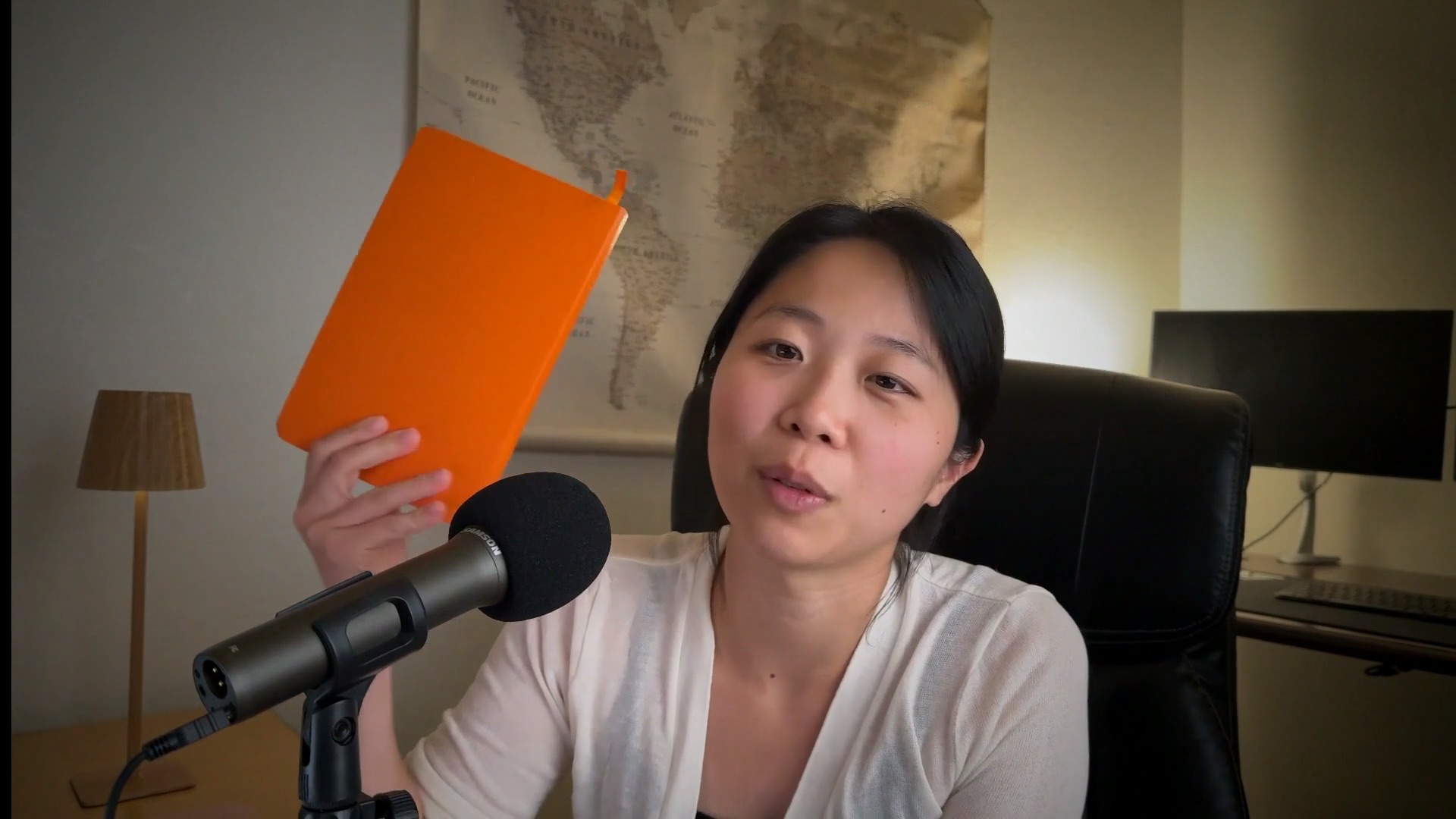
The thinking is yours. The speed is AI's. Get the order right.
And her advice for the imposter syndrome that stops most people before video one:
"Just start. Click record and click upload. That's what it is — it's two things."
FAQ
What is an AI content system?
An AI content system is a repeatable pipeline that uses AI tools to handle the research, scripting and packaging stages of content creation, so you only spend human time on filming and judgement calls. Sandy Lee's version finds outlier videos in her niche, analyses their format, and drafts scripts with her frameworks — cutting days of work down to a couple of hours.
How much money can you make with AI content?
Sandy reported $52,000 of combined income in July 2026 — $25,000 from sponsorships, around $10,000 from her Skool community, $2,000 from her app, $1,500 from AdSense, plus her salary. Those numbers came after roughly seven months of consistent publishing and 67,000 subscribers, not overnight. That combines salary with business receipts and does not establish profit or typical earnings. AdSense was the smallest of the four disclosed business streams.
Can you build an AI content system with a full-time job?
Yes — Sandy runs hers around a full-time job and three kids under eight. The two habits that make it possible are batch filming on a set day and letting AI compress the research and scripting stages. If you're time-poor, repurposing one video into a week of social posts with AI is the same principle applied to distribution.
Do you need to be technical to use Claude Code for content?
No. Sandy is not a developer — she studied political science and spent over a decade in sales and marketing before building her system, and her app, with Claude Code. Her one rule is to read every skill file line by line so you understand what the AI is doing before you rely on it.
Is it okay to copy other creators' video ideas?
Copying the format is fine; copying the content word-for-word is not. Sandy's rule is to borrow the proven topic, title pattern and hook structure, then fill it with your own story and expertise — that's how her reel went from 900 to 10,000 followers in two days.
Sandy built her system solo, at nap time, around a day job. You don't have to do it that alone. Inside the Wright Mode AI Membership we build exactly these kinds of content systems together — real workflows, real accountability, and me in your corner when Claude does something weird.
You can find Sandy on YouTube, at Slee Studio, and in her AI Content Systems community.